News
Êzdîkî – the language of the Ezidis?
This article was translated from German. Read the original (German)
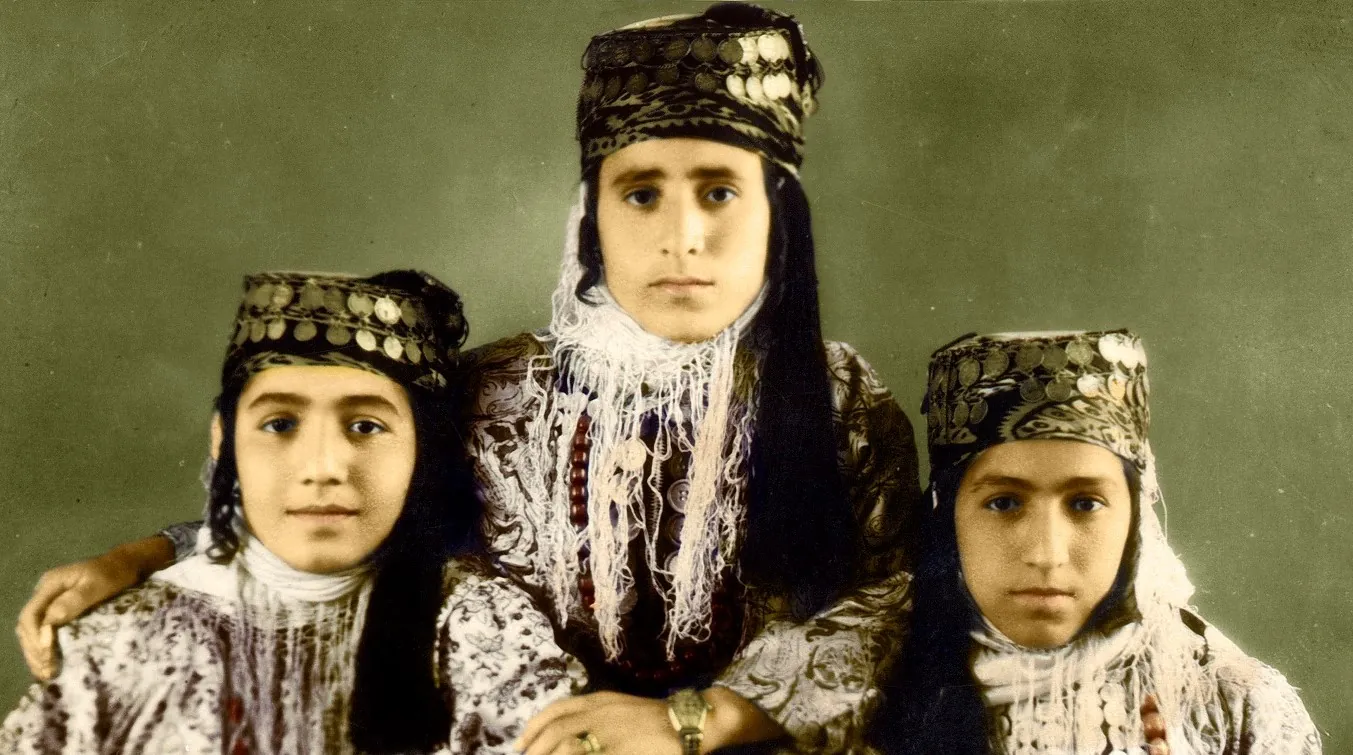
Georgia, 1950
“The Ezidis, however, call their language «zyman e ezda» (the language of the Ezidis)”, Ernest Chantre, “Notes ethnologiques sur les Yésidi”, 1895, Turkey.
Since the beginning of the genocide in 2014, the Ezidi community has become the subject of countless discussions. On the one hand because its religion and culture are still unfamiliar to most people, and on the other because the obvious lack of information about its history repeatedly leads to lively debates about Ezidi identity, even among Ezidis themselves. Young Ezidis and Kurds who are active on social media in particular regularly discuss the ethnic affiliation of the Ezidis and their language. This often leads to opposing, even hostile views, especially when some Ezidis insist on “Êzdîkî” as the name of their language. But does it really exist? This question will be explored below.
Mother tongue and sacred language
The mother tongue of almost all Ezidis, and at the same time the Ezidi sacred language, is the language known, among other names, as Kurmanji (Kurmancî). Almost all Ezidi prayer texts, hymns (qewls) and so on have been handed down in Kurmanji. This language is therefore of special importance to the Ezidis.
Kurds regard Kurmanji as a dialect of the Kurdish language, generally assuming that there is only one Kurdish language, divided into various dialects and vernaculars. There is, however, also the view that Kurmanji is one of several independent Kurdish languages.
Especially – but not only – today’s Ezidis from the post-Soviet region mostly use the name “Êzd(î)kî” for their language. The word “Êzdîkî” is made up of the stem “Êz[î]dî” and the suffix “-kî”, which turns the stem into an adjective. Translated, “Êzdîkî” therefore means “Ezidi”. So there are three so-called glossonyms – names of this language – in use: “Kurmanji” (Kurmancî), “Êzdîkî” and “Kurdish” (Kurdish “kurdî”).
At first this seems a completely trivial observation, but this is precisely where the problem begins: there is great intolerance towards the use of the glossonym “Êzdîkî” – the name is vehemently rejected, among others, by intellectual circles of Ezidis, most of whom are Kurdish-nationalist in outlook. People often argue at great length against granting the Ezidis this name for their language. The reasons for this, and the social excesses this problem has led to, are examined in detail here for the first time.
When Ezidis from the post-Soviet region today use the glossonym “Êzdîkî” in public as the name of their language, the mere use of the word often provokes hostile reactions – from Kurdish-nationalist circles, which often include Ezidis who were socialised in a Kurdish-nationalist environment. They regard the term “Êzdîkî” as an attack on the national unity of the Kurds. The arguments and disputes resulting from these opposing views, which are often ideologically charged, make it difficult to discuss the matter objectively. General rejection is expressed in sentences such as: “No such language exists”, “That’s Kurdish, not Êzdîkî”, “If you want to speak Êzdîkî, find yourselves a language other than Kurdish, because that one is ours”, or mockingly: “If you speak ‘Êzdîkî’, do the others speak ‘Muslim’?”.
There are a number of such constantly repeated patterns, which cannot all be presented here. The argument sometimes becomes more complicated when political activists, journalists and intellectuals – even Ezidi professors – hold such or similar dismissive views. Other Ezidi intellectuals have so far kept out of this discussion entirely, because merely dealing with the subject is branded as treason or separatism by the Kurdish side.
The general tenor can be summarised as follows: the Ezidis should give up a name of their own for their language in favour of a higher goal, namely Kurdish-nationalist unity. The Ezidis’ own name for it is seen as a threat to a national feeling among the Kurds that is still very fragile today.
So does “Êzîdîkî” exist at all, or is it a politically and ideologically motivated coinage? Only thorough clarification can lead to a consensus and thus to an end to ideological disputes.
Language and glossonym
In these disputes, it can be observed that opponents of the term “Êzdîkî” do not distinguish between the language itself on the one hand and the name of the language (the glossonym) on the other. The sentence “You speak Kurdish, not Ezidi” can be understood as contradicting the claim that Ezidi is a different language from Kurdish – or as contradicting the claim that the glossonym, i.e. the mere name “Êzdîkî”, exists at all, and that only “Kurdish” exists. What exactly is being claimed or meant almost always remains unclear – probably because the person making the claim is often unclear about it themselves. The fact is, first of all, that “Kurmanji” and “Êzdîkî” are glossonyms, i.e. names of the same language variety. One and the same language can certainly have different glossonyms. There is nothing unusual about that. For example, “Bosnian”, “Serbian” and “Croatian” are different names for the same language. In Pakistan the name Urdu and in India the name Hindi is used for the same language. These are examples in which different groups use different names for the same language, spoken by all of these groups. Using the glossonym “Êzdîkî” is not “wrong” simply because other groups speak the same language and use a different name for it. It is not unusual for the same language to have several names.
So do the Ezidis speak Kurdish?
It is often said that Ezidis speak “Kurdish” or are “Kurdish-speaking”. Since, as mentioned, many Ezidis use the name “Êzdîkî”, it is questionable whether this statement is correct as it stands. For example, it would be very unusual to claim that Indians speak Urdu or that Pakistanis speak Hindi. The same applies, for example, to Serbs and Bosniaks with regard to Serbian and Bosnian.
Even the question of how the “Kurdish” language is to be defined – in particular whether Kurdish comprises several languages or different dialects of just one language, and which language varieties are to be included in either case – cannot be answered clearly. Kurds themselves mostly take the view that “Kurdish” (Kurdish “kurdî”) is one language with various dialects such as Kurmanji, Sorani, Zazaki and Gorani. But if you read the German or English Wikipedia articles, for example, they speak of “Kurdish languages” in the plural; the Kurmanji version of the same encyclopedia, on the other hand, describes Kurdish as one language with various dialects.
There is no consensus among linguists on how to distinguish between language and dialect. Probably the most widespread view is based on the criterion of mutual intelligibility. According to this thesis, all mutually intelligible language varieties are merely dialects of one language, while varieties (or groups of varieties) that are not mutually intelligible belong to separate languages. Why even this criterion is not convincing and has therefore not led to a firm consensus is shown by the following problem: in a dialect continuum – a chain of mutually intelligible language varieties – a variety at the end of the continuum may be mutually intelligible with a neighbouring variety or language outside the continuum, while the other varieties within the continuum are not. The criterion of mutual intelligibility therefore does not allow clear boundaries to be drawn; instead, various boundaries can be drawn, each dividing the same chain of varieties differently into languages and dialects – and these divisions then contradict one another. There is therefore no scientifically undisputed criterion for distinguishing between language and dialect. The question is even asked whether the distinction can be justified scientifically at all. It probably cannot. The distinction between language and dialect is therefore often made less for scientific reasons than for social or political ones. The choice of a language’s name may be made for the same reasons, for example when the name of the language is meant to create a link with ethnicity and/or homeland, so that the glossonym corresponds to the ethnonym and/or the toponym (example: German – Germans – Germany). The classifications are therefore artificial, not natural.
It is possible that a person who only understands Low German (there are such people in the USA, whose ancestors emigrated before compulsory schooling was introduced) understands a Dutch speaker better than Bavarian German. Another example is Swedish, Norwegian and Danish: sometimes two speakers of particular varieties of two of these languages understand each other better than two speakers of different varieties of the same language. This shows that classifying groups as ethnic groups or nations by the criterion of language is a construct – and thus artificial, not predetermined by the “nature” of the language. The same even applies to other characteristics such as race, culture, descent and so on. This insight is now accepted in serious social science (in the now prevailing constructivist approach, as opposed to the primordialist one), and it contradicts many nationalist-ideological views. The world’s best-known theorists of nationalism therefore describe nations – and thus, in the case of ethnic nationalism, ethnic groups as well – as “imagined communities” (Benedict Anderson) and “contingent” (Ernest Gellner), whose emergence is based on “invented traditions” (Eric Hobsbawm).
Kurdish nationalism, for example, has developed a narrative of Kurdish ethnic continuity going back thousands of years. In it, the Ezidis are included as original Kurds (so-called “kurdên resen”) with a “Kurdish-speaking” religion who did not adopt Islam (a foreign element) and thus kept the “original religion of the Kurds”. The narrative of a common ethnic continuity, however, is a purely ideological construct to legitimise a nationalism. Yet today there are quite a few Ezidis who believe this narrative completely uncritically. This is an example of how a group’s ethnic self-definition can be changed by an ideological narrative that has little to do with actual history. Or, as Ernest Renan put it on 11 March 1882 in his famous lecture “Qu’est-ce qu’une nation?” (What is a nation?): “Forgetting – I would even say historical error – is an essential factor in the creation of a nation, which is why progress in historical studies is often a danger for nationality.” In fact, before the collapse of the Ottoman Empire – which coincides with the rise of nationalism in the region – there were separate and independent ethnogeneses of the Kurds and the Ezidis; an ethnic consciousness spanning religions was alien to the spirit of the time, and the Ottoman millet system also classified social groups by religious affiliation. However, the ethnogenesis of the Ezidis will not be traced here on the basis of historically verifiable facts. The focus here is mainly on language.
In the case of the Kurds, it can be observed that, although speakers of the various “Kurdish dialects” – such as Kurmanji, Zazaki, Sorani and Gorani – probably cannot easily understand each other in most cases, they regard all these varieties as dialects of one language, the Kurdish language. Or try to classify Luri (Kurdish “loranî”): a language of its own, a Kurdish dialect or a Persian dialect? The criterion of mutual intelligibility is often not met. But the fact that a group speaks different languages does not necessarily rule out its character as an ethnic group or nation. There are nations with more than one language, such as Switzerland. Conversely, a shared language does not necessarily make a common nation. Different nations often share the same language. So even if one assumes that there are several Kurdish languages (which most Kurds do not), this does not rule out a common Kurdish nationality. On the other hand, groups that share a language with the Kurds do not necessarily have to be classified as belonging to the Kurdish nation or ethnic group.
In light of the above, using “Êzdîkî” is not “wrong” in any sense. Nor can Êzdîkî simply be equated with Kurdish: on the one hand, Kurdish cannot be clearly delimited by objective criteria (since the distinction between languages and dialects is often subjective); on the other, different groups that speak the same language may well use different glossonyms. The only thing that can be stated as objectively true is that Kurmanji and Êzdîkî denote the same language variety.
Êzdîkî in the past and present
As mentioned, the glossonym “Êzdîkî” is today used almost exclusively by Ezidis from the post-Soviet region. This raises the following questions: which other glossonyms have the Ezidis used over the course of history up to today? And what about the other Ezidis?
Many Kurdish nationalists – above all older so-called “Kurdish-Ezidi intellectuals” (as this class is commonly called among other Ezidis) – have tirelessly tried, and still try, to get the Ezidis to use the name “Kurdî” (Kurdish) instead of “Êzdîkî” (Ezidi). This has been especially true since Êzdîkî became an officially recognised minority language in Armenia after the collapse of the Soviet Union, and school books were even printed in “Êzdîkî” with state support. There is no language called “Êzdîkî”, is often their credo. Armenia’s recognition of “Êzdîkî” as a language, they say, is the work of Armenian nationalists who wanted to divide the Kurdish people by separating the Ezidis ethnically from the rest of the Kurds. And the Ezidis who agree with this policy are said to be uneducated, ignorant and puppets of foreign interests. Statements of this or a similar kind can be found from almost all “Kurdish-Ezidi intellectuals”.
Is this true? Did Armenians invent the glossonym “Êzdîkî” in the 1990s for political-ideological reasons and foist it on the Ezidis? This is clearly not the case. Anyone who spends time today as a participant observer among post-Soviet Ezidis will find that the word “Êzdîkî” is used in everyday life right across society – including by very old people. If you ask them, without expressing any Kurdish-nationalist expectations, whether “Êzdîkî” was also used during their childhood – that is, long before Armenia’s independence – they will answer yes as a matter of course. Accordingly, the “Kurdish-Ezidi intellectuals” from Armenia mentioned above, who deny the existence of “Êzdîkî” and fight against its use, must also know the name “Êzdîkî” from their childhood. And that is indeed the case, but it is kept quiet. Several people have made this astonishing discovery after getting to know Ezidi society in the Caucasus more closely. Christian sects that began proselytising in the former Soviet Union after the fall of the Iron Curtain published a “Bible in Êzdîkî”. They chose neither “Kurmanji” nor “Kurdî” in order to convert the Ezidis because they hoped for greater missionary success, as “Êzdîkî” was more familiar to people.
Against this background, it is interesting to ask whether “Kurdî” and “Kurmancî” were also used alongside “Êzdîkî” in the Soviet Union – a time when, for the first time in history, Ezidis lived in a state that made education possible for them and actively promoted cultural participation in their mother tongue on a scale historically unprecedented for the Ezidis. It left behind an extensive cultural heritage that is still drawn upon today.
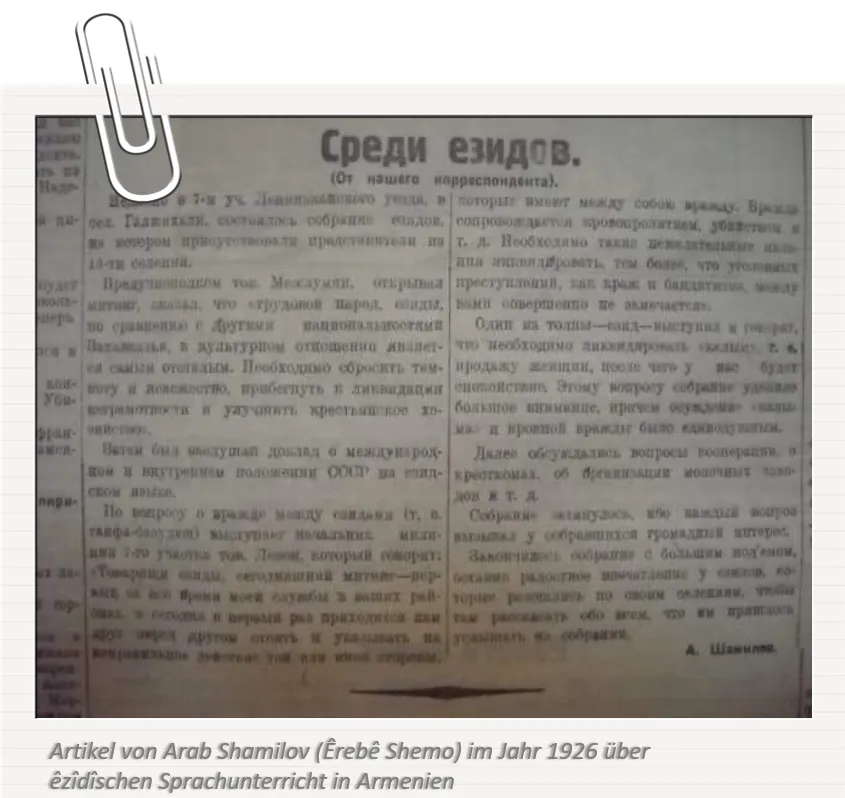
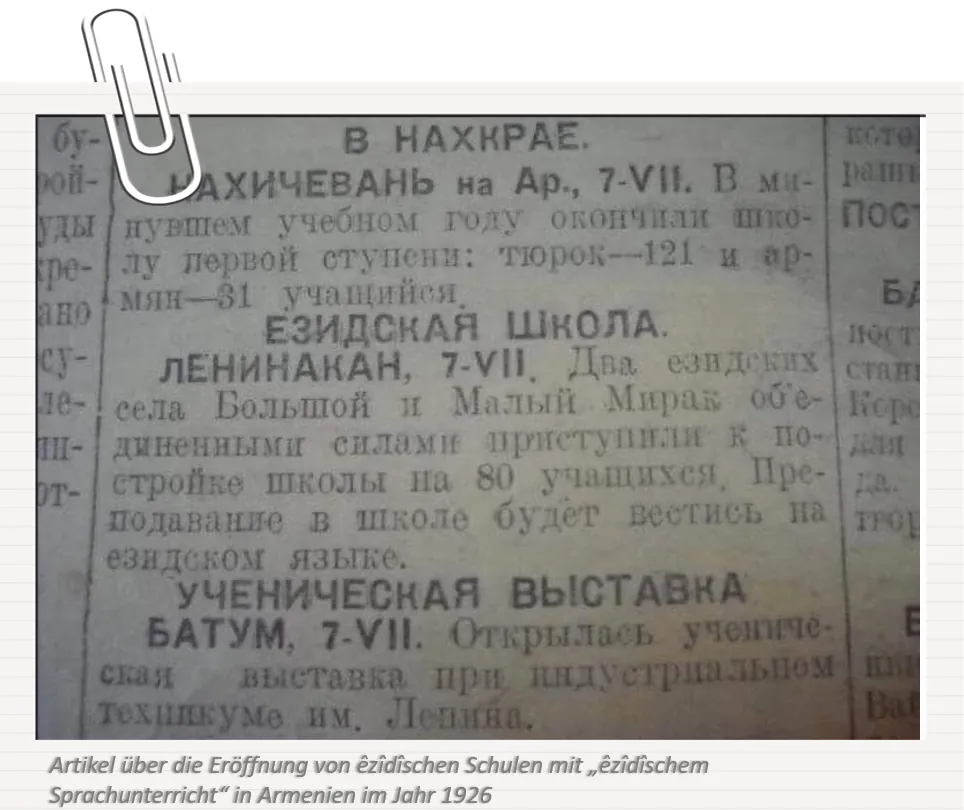
The early development can be illustrated by Arab Shamilov (Erebê Şemo). Arab Shamilov came from an Ezidi sheikh family (the Shechobekir sheikhs within the Qatani line of descent) and is historically known as the author of the first novel in Kurmanji. As late as 1926, Shamilov wrote in an article in a Russian-language Soviet newspaper: “Two Ezidi villages, Bolshoi and Maly Mirak, have begun building a school for 80 pupils. Lessons at the school will be held in the Ezidi language.” Arab Shamilov, the author of the first Kurmanji novel in history, speaks here of an “Ezidi language”. In later years, and then continuously until the end of the Soviet Union, the name “Ezidi” for the language disappeared from public life; Ezidis themselves used “Kurmanji” towards the outside world. The reason why Soviet Ezidis used the name “Êzdîkî” among themselves during this period, but no longer towards outsiders, can be explained by Stalin’s nationalities policy, which was implemented in the 1930s.
After Lenin had commissioned Stalin to study the nationalities question in the Soviet Union, Stalin wrote in 1913 that a common language was a characteristic feature of a nation. He nevertheless mentioned that different nations can have the same language. According to him, then, Ezidis and Kurds would not necessarily form the same ethnic group. The anti-religious tendency of his socialist ideology, however, suggests that for him religious affiliation was not a criterion that could found an ethnic group or nation. Although he accepted the right to national self-determination, how a nation was to be defined was to be decided from above in the way most expedient for socialism. In this definition, religious affiliation had no place as a characteristic. Ethno-religious identities – and thus glossonyms referring to an ethno-religious identity – were therefore undesirable. This led to the disappearance of “Êzdîkî” as a glossonym in public life, in favour of Kurmanji or Kurdish. These changes in political circumstances also seem to have influenced Arab Shamilov and later authors; after 1930 he no longer used “Ezidi” either. The situation changed abruptly after the collapse of the Soviet Union, the revival of Armenian nationalism and Armenia’s independence.
Once again, political circumstances changed that influenced the Ezidis and still do today. Muslim Kurds were no longer welcome in Armenia: Armenia was at war with Azerbaijan over the Nagorno-Karabakh region and feared that the Muslim Kurds would side with the Azerbaijanis, above all because of their shared Islamic faith; Armenians also remembered the Muslim Kurds as participants in the genocide of the Armenians around 1915. Practically all of them left Armenia. In addition, the ideologies of Armenian and Kurdish nationalism now confronted each other as competitors. What Armenians call “Western Armenia”, Kurds call “Northern Kurdistan”. For all these reasons, there was a tendency in Armenia to weaken the “Kurdish factor” as much as possible – to which the policy of a separate Ezidi ethnic group also contributed. After the Soviet nationalities policy and Kurdish political activism in the 20th century had tried to push the Ezidis in one direction – that of Kurdification – there was now also a political force trying to influence them in the other direction. This situation led to considerable tensions within the Ezidi community of Armenia, which at times turned violent. An intellectual Kurdish-nationalist class of Ezidis, socialised in the Soviet Union, saw the legacy of their life’s work, devoted to Kurdish nationalism, in danger if the Ezidis no longer identified as Kurds. Armenia, however, recognised “Êzdîkî” as an official minority language – and “Kurdish” alongside it.
It should be noted that in Iraqi Kurdistan, for example, the policy of Kurdification towards the Ezidis was and is far more radical than the Armenian policy, which was based not on coercion but merely on a proactive policy of recognition. Today’s Kurdish media, above all in northern Iraq, such as Rudaw or Kurdistan24, constantly try to charge the term “Ezidis” with Kurdish-nationalist meaning in order to achieve a suggestive effect; there is almost never a report about Ezidis that does not also state that they are Kurds. A 2009 Human Rights Watch report shows what consequences it can have when Ezidis in northern Iraq do not want to define themselves as Kurds: two members of the Ezidi party ISLAH, which promotes an independent Ezidi identity, were seized by Kurdish security forces (Asayish) and tortured during interrogation. One of them was asked during interrogation, “What is your language?”, to which he replied, “Ezidi”. He was told: “No, Ezidis have no language, they speak Kurdish.” As punishment, he was taken away and tortured further (see link).
Scholarship, too, is not free of ideology in this context of identity politics. In Armenia, orientalists use the word “Êzdîkî”, which is a thorn in the side of many Kurdish authors. Western scholars, on the other hand, never use the word “Êzdîkî” and always describe the Ezidis as “Kurdish”-speaking. This is probably because, during their field research, Western scholars mainly came into contact with people socialised in a Kurdish-nationalist environment and were thus under the influence of Kurdish nationalism – which still seems to be the case today. Both sides are to be criticised here, since the task of scholars can only be to find out what Ezidis really call their language and how they identify themselves – and precisely not how they are portrayed by others or what best suits one’s own narrative.
Today the glossonym “Êzdîkî” is common above all among Ezidis from the former Soviet Union; in addition, the name is also gaining popularity in the Ezidi diaspora in Germany and in some parts of their settlement areas in Iraq. Interestingly, however, Ezidis of the past who are not ancestors of the Soviet Ezidis also used this glossonym. The accusation that the Ezidis invented the term “Êzdîkî” to set themselves apart ethnically from the Kurds, and that it was promoted by the Armenian state, can therefore be laid to rest. During his research trips in 1895, the anthropologist Ernest Chantre interviewed Ezidis in Birecik in present-day Turkey. He reports as follows (translated from French):
“Both [Ezidis and Kurds – ed.] speak ‘Kourmandji’. However, the Ezidis call their language ‘zyman e ezda’ (the language of the Ezidis), and they claim that it is the Kurds who speak their language, and not they who speak the language of the Kurds.”
(“Les uns et les autres parlent le «Kourmandji». Quoique les Yézidi appellent leur langue «zyman e ezda» (langue des Yézidi) et prétendent que ce sont les Kurdes qui parlent leur langue, et non pas eux qui parlent la langue des Kurdes.” (Ernest Chantre, “Notes ethnologiques sur les Yésidi”, 1895))
So there were also Ezidis outside the Armenian sphere of influence who, long before, did not even want to use the name “Kurmanji” for their own language and preferred to speak of “the language of the Ezidis”. It is not surprising that the nationalist narrative mentioned above ignores such sources. And scholarship, too, has to this day – there is no other explanation – deliberately suppressed such sources.
What is also certain, however, is that many Ezidis used, and still use, the name “Kurmanji”. For Kurds and Ezidis alike, the use of “Kurdî” (Kurdish) has only been promoted in recent decades, above all by Kurdish television channels with a nationalist agenda – very successfully, from today’s perspective. “Kurmanji” used to be more common. Today, Kurds see Kurmanji as a dialect of the Kurdish language, which is said to include many other dialects such as “Sorani” or even “Zazaki”. Even if the Ezidis used to say “kurmancî”, there is no demonstrable etymological connection between the words “kurmancî” and “kurdî”. Attempts to establish such a connection have so far led to different, sometimes contradictory theories. One theory (MacKenzie) holds that “kurmanc” is a compound of “Kurd” and “manc” for Mede. Another theory claims that “Kurmancî” derives from the name of the city of Kermanshah (Kurdish “kirmanşan”). Nevertheless, Ezidis today sometimes also use the word “Kurdî” when it helps outsiders understand.
Also interesting at this point is the fact that, to this day, a large part of the Ezidis use the term “Kurmanc” exclusively to refer to Muslim Kurds. It is above all Kurmanji-speaking Kurds in Turkey and Syria who call themselves Kurmanc. Yet this endonym (self-designation) is still used by Ezidis exclusively as a distinguishing marker – even though many of them call their language Kurmancî, define themselves as Kurds and have lived with Muslim Kurds in the same area. This has historical, ethno-religious reasons that are hardly present in people’s minds today.
It is also telling that today’s Ezidis who were socialised in a Kurdish-nationalist environment do not object to the self-designation “kurdî”, which is relatively new for Ezidis historically, but do object to the self-designation “êzdîkî”, which has been used for much longer. They argue that “our language was always ‘kurdî’, and ‘êzdîkî’ was newly invented to divide the Kurds” – asserting almost the opposite of the truth, and with astonishing conviction. “Êzdîkî” should not be used, they say, but rather “Kurdî”, and everyone should identify as Kurds; after all, Muslims do not speak “Muslim” either. The fact is that language names do not follow laws of nature or logic. Of course it is conceivable to call a language “Muslim”, even though no such language probably exists anywhere. But what others do or do not do does not create any necessity to do the same – or not. There is, for example, “Yiddish”, a glossonym used by Jews that translates as “Jewish”. “Êzdîkî” is therefore not an isolated case. A factor here is probably that Islam and Christianity are religions with a universal claim and wide distribution, so that, given the diversity of languages, a glossonym borrowed from the name of the religion would not help distinguish between languages. For Jews and Ezidis, however, this is different.
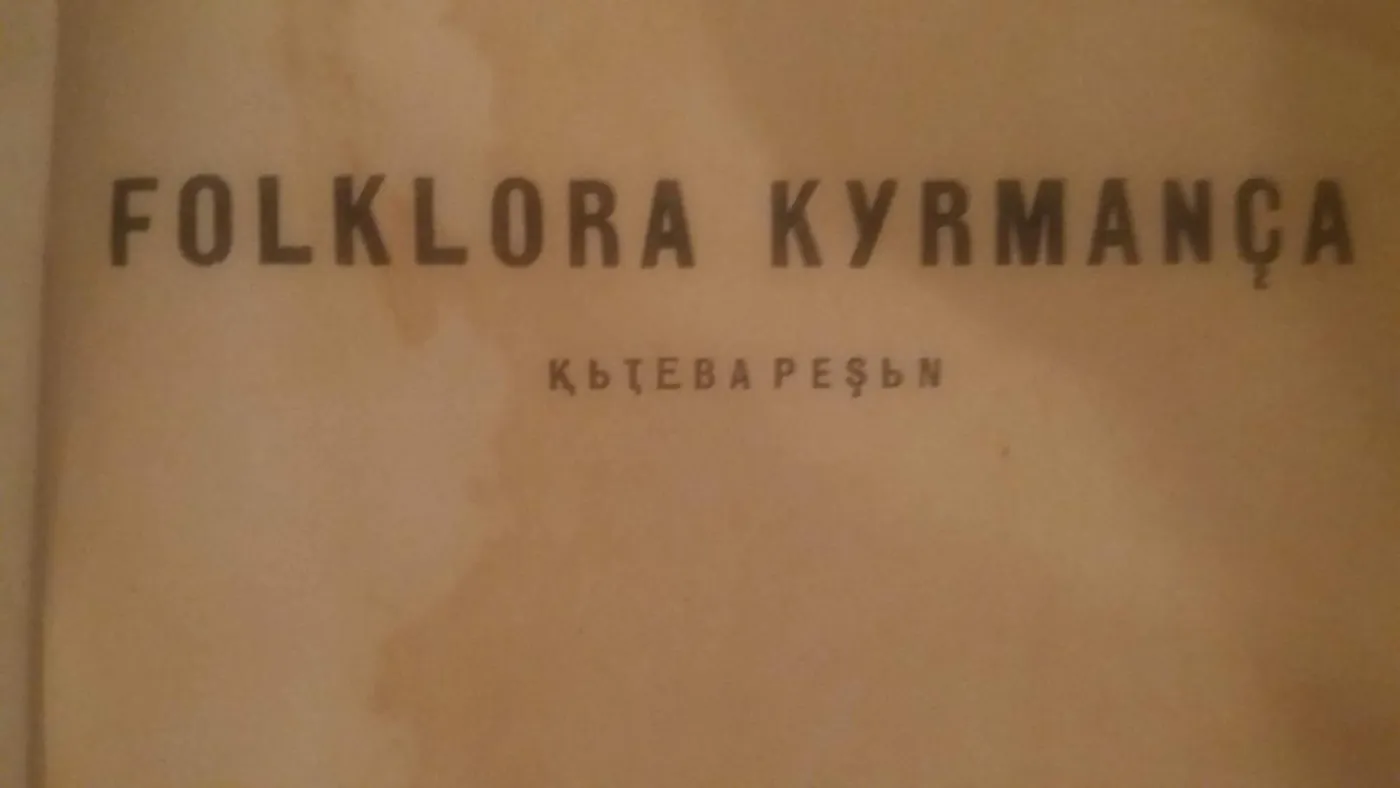
Against this background, two examples illustrate how attempts are made to construct a nationalist narrative. Arab Shamilov (Erebê Şemo), the author of the first novel in Kurmanji, gave it the title “Shivane kurmanca”, which can be translated as “The Shepherd of the Kurmanj”. Some Kurdish nationalists did not like this title. For if “the first Kurdish novel in history” speaks only of “Kurmanj” and not of “Kurds”, it is less useful as a national symbol for legitimising Kurdish nationalism. So later editions of the book were simply printed with the title “Shivane kurda” (The Shepherd of the Kurds). Another example: “Folklorê kurmanca” (The Folklore of the Kurmanj) by Heciye Cindî was simply renamed “Folklorê kurda” (The Folklore of the Kurds).
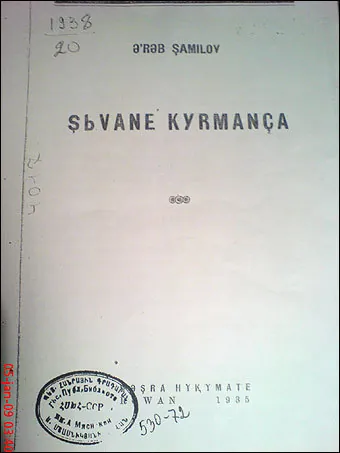
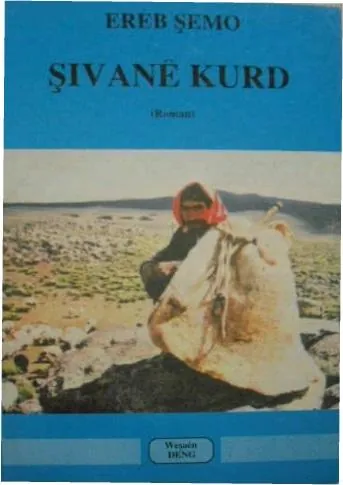
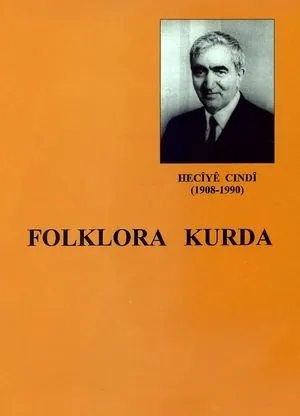
The question arises why certain intellectuals and politically active “Ezidi Kurds” fight so vehemently against the glossonym “Êzdîkî” – even though some of them, namely those from the former Soviet Union, must be familiar with the name from their own childhood, which they themselves do not admit. The reason is their internalised Kurdish-nationalist ideology. Ideologised themselves, they strive to ideologise others; ideology aims to change the will of others – in this case, to promote a Kurdish national feeling through identity politics in the form of language policy. That one cannot force others to do so is ignored. Their nationalist-ideological blindness blocks their access to objective knowledge. They cannot or will not accept that Ezidis use the name “Êzdîkî”, because there should only be “Kurdî”. That is why, in their eyes, those Ezidis are stupid, uneducated, ignorant, puppets of the oppressors of the Kurdish people and thus traitors to the nation. They, on the other hand, regard themselves as the intellectual elite. In truth, this ideological blindness has led to fascistoid tendencies and unreason. Not a single Kurdish-nationalist Ezidi, for example, has spoken out against the torture of Ezidi activists reported by Human Rights Watch, because they share the same nationalist doctrine: Ezidis are Kurds and speak Kurdish. They are pure nationalist ideologues and almost completely uninformed and uneducated in terms of the theory of nationalism and anthropology. Younger, more open-minded generations of Ezidis increasingly have nothing but incomprehension for these people and regard them as tragic figures in Ezidi history.
It is at times astonishing with what energy, today, especially intellectual circles among the Ezidis try to distort the history of their own ancestors in favour of apparently nationalist goals – or even to deny it altogether, reinterpret it and thus falsify it. In other words, they fight against a heritage and an identity for which the Ezidis are still paying with their lives, as the events of 2014 have shown once again.
Source: © ÊzîdîPress, 12 September 2018 (German original)